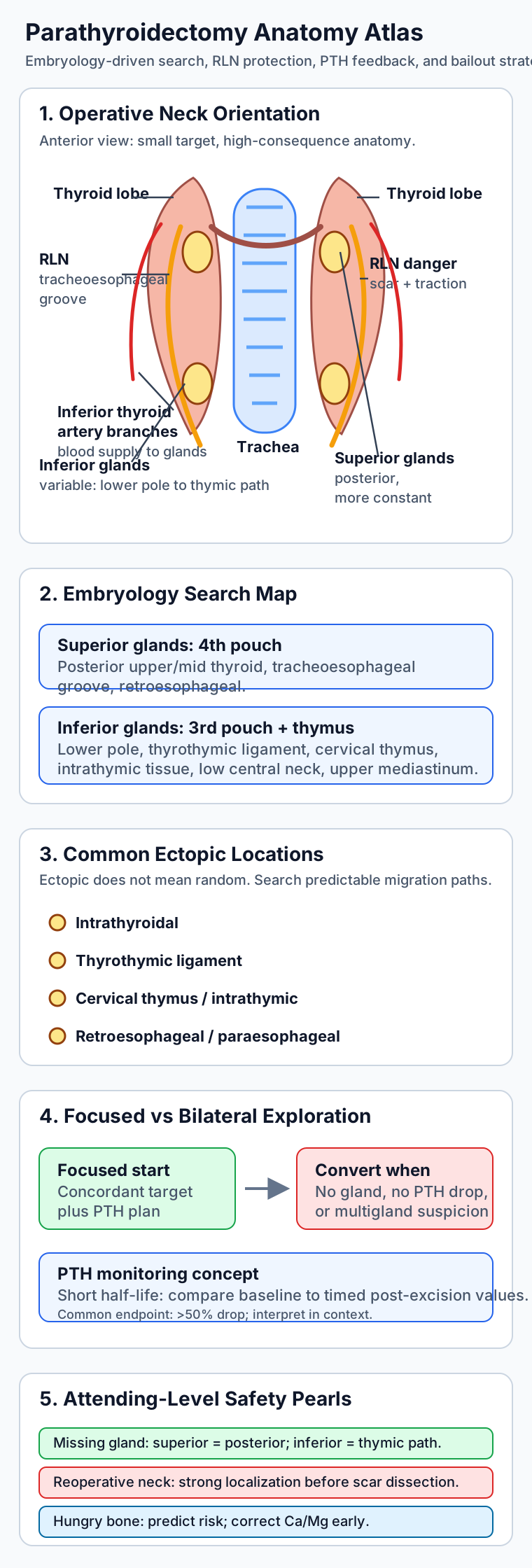
Confirm indication and localization
What: Review calcium/PTH physiology, symptoms, renal/bone disease, localization studies, prior operative history, and voice status when indicated.
Why: The disease pattern determines focused versus bilateral exploration.
Pitfalls: Treating discordant imaging as concordant or skipping reoperative laryngoscopy.
Expose with nerve-aware orientation
What: Develop the neck dissection along known thyroid/parathyroid landmarks while respecting the tracheoesophageal groove and RLN.
Why: Small gland surgery happens next to high-consequence structures.
Pitfalls: Traction in scar, blind clipping, or confusing lymph node/fat/thyroid nodule for parathyroid tissue.
Remove the target gland
What: Excise the abnormal gland with careful handling and preservation of normal tissue vascularity.
Why: Cure requires removing hyperfunctioning tissue without causing permanent hypoparathyroidism.
Pitfalls: Capsular violation when carcinoma is suspected or devascularizing normal glands.
Interpret intraoperative PTH
What: Compare baseline and timed post-excision values using the institutional protocol.
Why: PTH response provides functional confirmation or warns that disease remains.
Pitfalls: Closing after a failed drop or misreading delayed clearance.
Convert when needed
What: Broaden to systematic exploration when the target is missing, PTH does not fall, or multigland disease becomes likely.
Why: A focused plan should not become focused persistence in the wrong operation.
Pitfalls: Random dissection instead of embryology-based search.
Plan postoperative calcium care
What: Monitor calcium, ionized calcium when needed, PTH, magnesium, symptoms, and ECG risk in severe hypocalcemia.
Why: Hungry bone syndrome and symptomatic hypocalcemia can follow a successful operation.
Pitfalls: Forgetting magnesium or delaying IV calcium for severe symptoms.