Positioning
What: Supine or semirecumbent with arm up and site exposed.
Why: Opens lateral chest wall.
Pitfalls: Poor exposure drives low or posterior placement.
Triangle of safety, pleural anatomy, tube positioning, complications, documentation, CPT, and wRVUs.
Tube thoracostomy drains air, blood, pus, or fluid from the pleural space. It is common, high-stakes, and unforgiving when placed blindly or too low. The learner must know chest wall anatomy, safe entry, finger sweep, tube direction, and immediate complication management.
Pneumothorax requiring drainage
Hemothorax
Empyema or complicated parapneumonic effusion
Traumatic chest injury with respiratory compromise
Postoperative or iatrogenic pleural collection
Need for pleural drainage when less invasive management is not appropriate
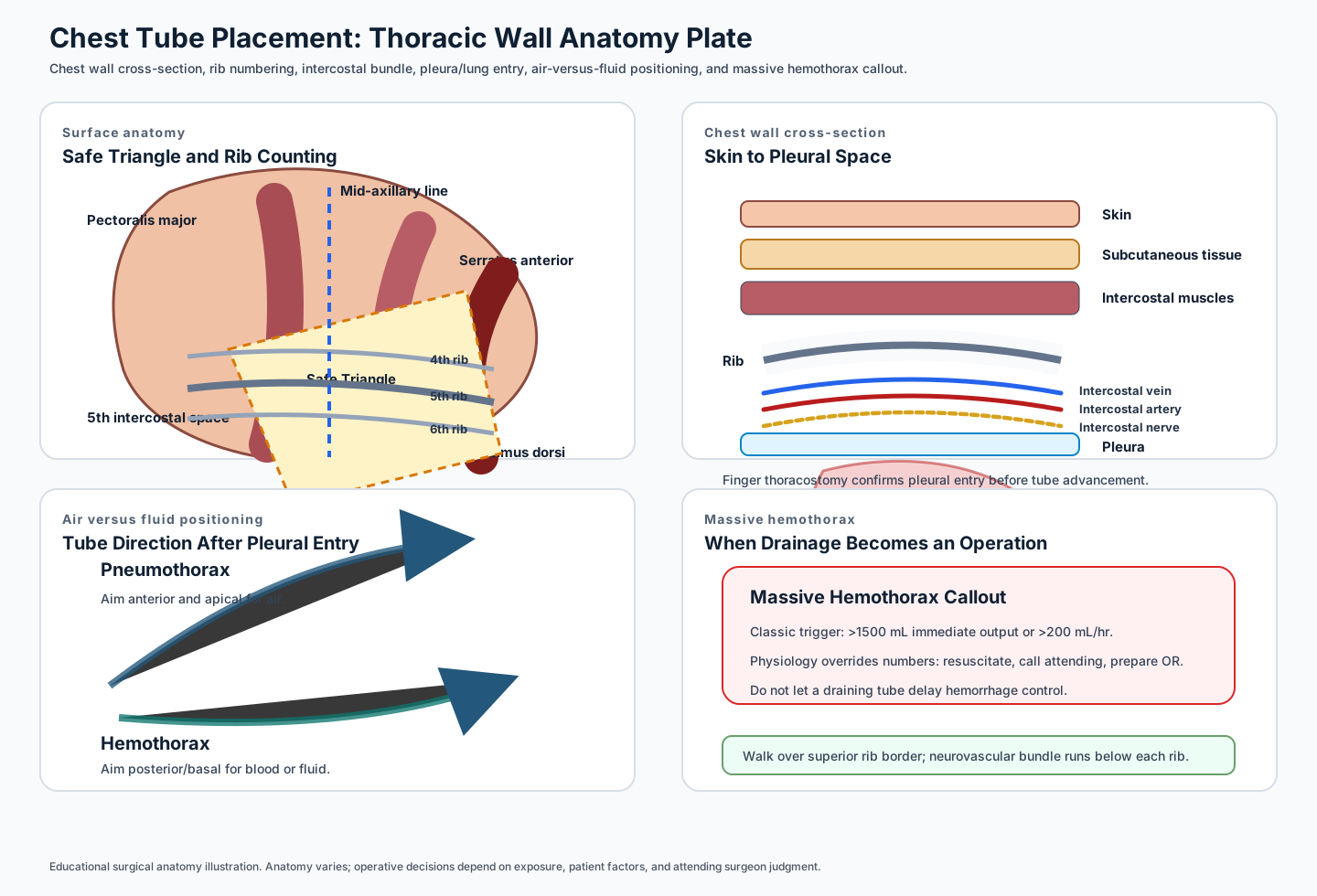
Triangle of safety: lateral border pectoralis major, anterior border latissimus dorsi, line above nipple/inframammary fold, apex below axilla
Intercostal neurovascular bundle under each rib
Pleura and lung surface
Diaphragm rises high on expiration
Internal mammary and lateral thoracic vessels
What: Supine or semirecumbent with arm up and site exposed.
Why: Opens lateral chest wall.
Pitfalls: Poor exposure drives low or posterior placement.
What: Choose safe interspace in triangle of safety.
Why: Avoid diaphragm and abdominal organs.
Pitfalls: Too low risks liver/spleen/diaphragm injury.
What: Anesthetize skin, periosteum, pleura; incise over rib.
Why: Pain control and controlled access.
Pitfalls: Inadequate anesthesia causes movement and unsafe force.
What: Dissect over the rib into pleural space.
Why: Protects neurovascular bundle.
Pitfalls: Trocar-style force is dangerous.
What: Confirm pleural entry and clear adhesions locally.
Why: Prevents subcutaneous or fissure placement.
Pitfalls: Skipping sweep risks false passage.
What: Direct tube apically for air or posterior/basal for fluid as clinically needed.
Why: Positions drainage target.
Pitfalls: Kinking or inadequate depth impairs drainage.
What: Suture, connect drainage, confirm function and imaging.
Why: Prevents dislodgement and verifies position.
Pitfalls: Not checking tidaling/air leak/output misses problems.
Click any card to reveal the answer. Use filters for level-specific review or Quiz Mode for one-question-at-a-time board prep.
Realistic case stems that teach operative judgment, prioritization, bailout thinking, and documentation discipline.
These cases are educational examples for surgical learning and documentation awareness. They are not patient-specific medical advice. Actual management depends on patient physiology, anatomy, local resources, attending judgment, and institutional protocols.
Scenario: the patient deteriorates after chest tube placement and the tube has no tidaling. Check the patient first, ensure the system is connected and not clamped, assess for malposition or tension physiology, obtain imaging if stable, and replace/reposition when needed.
Bleeding: recognize chest wall or intrathoracic hemorrhage; prevent by going over rib; manage pressure, tube output monitoring, or operation if massive.
Lung injury: recognize air leak or worsening pneumothorax; prevent with blunt technique/finger sweep; manage drainage and reassessment.
Abdominal organ injury: recognize low placement, peritonitis, bleeding; prevent with correct site; manage urgently.
Subcutaneous placement: recognize poor function and imaging; prevent with finger confirmation; replace correctly.
Infection/empyema: prevent sterile technique and remove when no longer needed; treat infection appropriately.
Values below are pulled from the FreeCPTCodeFinder CPT database at runtime so RVUs and estimated Medicare payments stay aligned with the coding engine.
Educational guidance only. This section is not a complete dictated operative note and should not be copied into the chart.
Safe site beats speed
Over the rib
Finger in the chest before tube advancement
Secure the tube well
Know what immediate output means
The dynamic CPT table supplies codes, RVUs, global periods, and estimated Medicare values. The surgeon still has to document the clinical facts that justify the selected code.