How One Flap Can More Than Double the WRVUs of a Below-Knee Amputation
Last reviewed: June 16, 2026
Most surgeons think of a below-knee amputation as a below-knee amputation. The leg comes off, the stump gets closed, everybody moves on.
That is not always the operation.
Sometimes the hard part is not removing the limb. Sometimes the hard part is building a durable, prosthetic-ready residual limb that can survive the real world: sockets, pressure, shear, diabetes, vascular disease, trauma, and the orthopedic soul-crushing experience known as "this looked better in clinic."
The difference is surgery, not coding.
The Numbers
| Procedure | CPT | wRVUs |
|---|---|---|
| Below-Knee Amputation | 27880 | 14.99 |
| Lower Extremity Flap Reconstruction | 15738 | 18.56 |
| Combined Total | 27880 + 15738 | 33.55 |
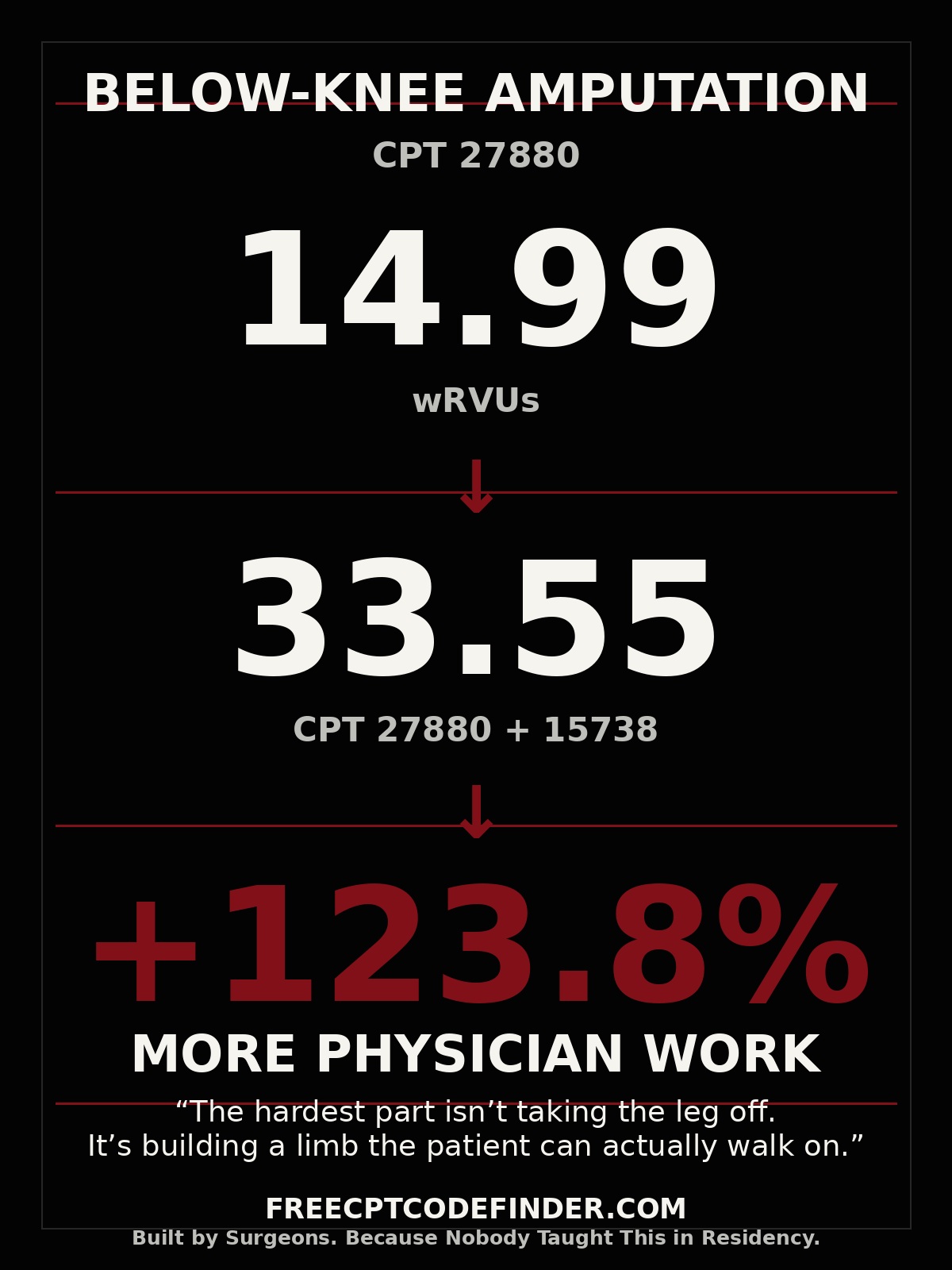
33.55 vs 14.99 wRVUs = +123.8% increase in physician work RVUs.
The flap reconstruction contributes 18.56 wRVUs. That means the reconstructive portion of the operation can generate more physician work than the amputation itself.
Not because anyone found a magic billing lever. Because formal flap reconstruction and myodesis are real operative work.
“The hardest part isn’t taking the leg off. It’s building a limb the patient can actually walk on.”
What Surgeons Miss
A straightforward BKA is one thing. A contaminated, ischemic, traumatized, infected, or previously operated limb with inadequate soft tissue is a different operation entirely.
These cases may require muscle mobilization, flap creation, soft tissue advancement, coverage of exposed bone, formal myodesis, and a deliberate residual limb construct. That is not "closure." That is reconstruction.
The hardest part is often building the functional residual limb. The patient does not care that the tibia is shorter. The patient cares whether the stump tolerates a prosthesis without ulcerating, breaking down, or sending them back to the OR.
The Documentation Problem
Surgeons frequently under-document complex residual limb reconstruction. They will spend another hour mobilizing tissue and anchoring muscle, then dictate:
Flaps were fashioned and secured.
That sentence is doing the work of a wet paper towel.
If you performed formal reconstruction, document it like a surgeon would need to understand it later:
- Why reconstruction was necessary
- Which tissues were mobilized
- How the flap was designed and advanced
- How bone coverage was achieved
- Whether formal myodesis was performed
- How the construct created a durable residual limb
What This Is Not
This is not a recommendation to add CPT 15738 to every below-knee amputation. That would be sloppy, aggressive, and exactly the kind of thing that gets surgeons in trouble.
Separate reporting depends on the actual work performed, current CPT language, CMS/NCCI edits, payer policy, operative documentation, and local coding/compliance review.
The point is simple: when the reconstructive work is real, the note should make it real to everyone downstream.
Internal Coding Links
Lower extremity amputation references: CPT 27880 below-knee amputation, CPT 27590 above-knee amputation, and CPT 28810 toe/metatarsal amputation.
Flap reconstruction references: CPT 15738 lower extremity muscle/myocutaneous flap, CPT 15734 trunk flap reconstruction, and CPT 15740 island pedicle flap.
Bottom Line
A below-knee amputation with separately supported lower extremity flap reconstruction is not the same operation as a basic BKA. The work is different. The technical burden is different. The documentation should be different.
If you are building a limb the patient can actually walk on, do not write the note like you merely took the leg off.
FREECPTCODEFINDER.COM
Built by Surgeons. Because Nobody Taught This in Residency.