The Most Expensive Sentence in Surgery: "CT Reviewed"
Last reviewed: June 2026
Quick Answer
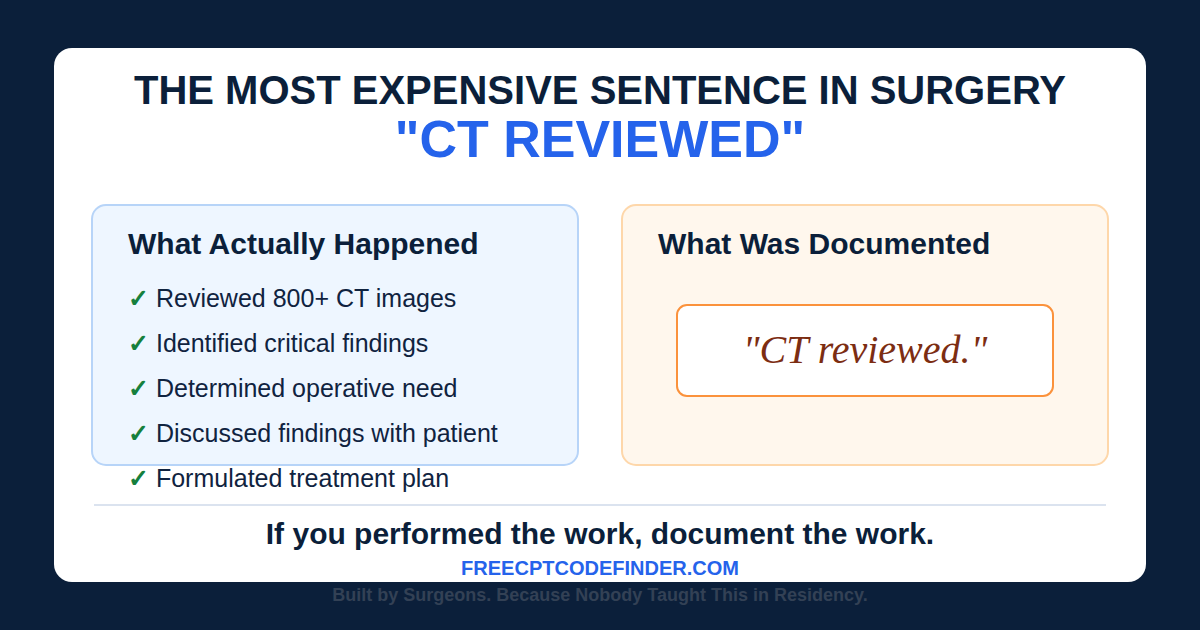
If you personally review imaging and that interpretation changes management, say what you saw and how it affected your decision. "CT reviewed" tells the chart almost nothing about your independent image review, medical decision making, surgical risk assessment, or operative planning.
Every Surgeon Has Done It
You spend 10 minutes reviewing a CT scan.
You identify findings that change management.
You discuss the scan with the patient.
You decide whether surgery is needed.
Then you document:
CT reviewed.
Two words.
Thousands of dollars of physician work over a career summarized in two words.
That is the problem. Not because every CT review automatically changes an E/M code. Not because a better sentence magically guarantees more reimbursement. It does not.
The problem is that the note fails to capture what the surgeon actually did.
Why Independent Image Review Matters
Independent image review matters because surgeons do not look at imaging the same way radiologists do.
The radiologist answers an imaging question. The surgeon answers a management question.
Is this patient obstructed?
Is there ischemia?
Does the scan explain the exam?
Can I watch this overnight, or do I need to open the abdomen now?
That thinking is part of MDM documentation. When personally reviewing imaging contributes to diagnosis, risk assessment, operative planning, or disposition, the note should say so.
This is education, not a reimbursement promise. Independent interpretation does not mean automatic upcoding. It does not replace payer rules, official E/M guidance, or institutional policy.
It simply makes the surgical consult note more accurate.
A Small Bowel Obstruction Example
The radiology report says:
Small bowel obstruction.
That is useful.
But when the surgeon opens the CT, the question is not just, "Is there an obstruction?" The question is, "Does this patient need an operation?"
The surgeon independently identifies:
- Transition point
- Mesenteric edema
- Free fluid
- Closed-loop morphology
- Concern for ischemia
Those are not trivia findings. They directly influence management.
A simple adhesive small bowel obstruction without concerning features may be observed with decompression and serial exams. A closed-loop obstruction with mesenteric edema, free fluid, worsening pain, and tachycardia is a different conversation entirely.
That is where physician documentation matters. The note should show the clinical bridge between the image and the decision.
Bad Documentation vs Better Documentation
Bad Example
CT reviewed.
This tells me almost nothing. It does not say who reviewed it, what was seen, what was independently interpreted, or how it changed the plan.
Better Example
I independently reviewed the CT abdomen and pelvis. Findings include mesenteric edema, free fluid, and a distal ileal transition point concerning for closed-loop obstruction. Given these findings and the patient's worsening abdominal pain and tachycardia, I recommend urgent operative exploration.
That second version is not bloated. It is not a coding gimmick. It is just better surgical documentation.
It captures independent image review, relevant findings, clinical context, risk, and the decision for surgery. It also helps the next surgeon, the hospitalist, the emergency physician, the APP, the resident, and the coder understand why the patient is going to the operating room.
How This Connects to E/M Coding and Work RVUs
E/M coding is driven heavily by medical decision making, not by note weight.
That is why "CT reviewed" is such a weak sentence. It may represent real work, but it does not describe the work.
If the physician personally reviewed imaging, identified findings, incorporated those findings into the assessment, discussed the decision with the patient, and used that information to recommend surgery, the documentation should reflect that pathway.
Better documentation can help the record support the level of work actually performed. That matters for work RVUs, physician productivity, compliance review, handoffs, and defensible care.
Again, the point is not to chase a higher code. The point is to avoid under-documenting the actual complexity of the encounter.
The Residency Problem
Surgeons spend years learning anatomy, physiology, operative technique, trauma, critical care, complications, and how to stay calm when the abdomen looks like a crime scene.
Then we receive almost no formal education on:
- Documentation
- Medical decision making
- E/M coding
- Independent image review
- Physician reimbursement
Most residents can explain the coagulation cascade in exquisite detail. Ask them how to document independent image review and you will often get a blank stare, followed by a note that says "CT reviewed."
That is not laziness. It is a training gap.
We teach residents how to interpret the scan. We teach them how to operate. We should also teach them how to document the thinking that connects the two.
The Goal Is Not Longer Notes
The goal is not longer notes.
The goal is better notes.
A good surgical consult note captures physician thinking. It does not need every lab value since the Bush administration, every medication ever prescribed, or a copy-forwarded review of systems nobody believes was reviewed line by line.
It needs the part that matters:
- What did you personally review?
- What did you independently identify?
- Why did it matter?
- What decision did it support?
That is the sentence surgeons should be writing.
Simple Language You Can Use Tomorrow
For suspected appendicitis
I independently reviewed the CT abdomen and pelvis. Findings include a dilated appendix with periappendiceal inflammation and no abscess. Given the patient's focal right lower quadrant tenderness, leukocytosis, and imaging findings, I recommended laparoscopic appendectomy.
Related CPT reference: appendectomy CPT coding.
For trauma laparotomy decision making
I independently reviewed the CT chest, abdomen, and pelvis. Findings include free intraperitoneal fluid without solid organ injury and increasing abdominal tenderness on serial examination. Given concern for hollow viscus injury, I recommended operative exploration.
Related CPT reference: trauma laparotomy CPT guide.
For same-day surgery decisions
When the imaging review supports the decision for urgent or major surgery, make the decision clear. That is also where modifier education may matter, especially for same-day major surgery evaluation. See the guide to Modifier 57 decision for surgery.
Where RVUReady Fits
This is exactly the kind of documentation gap RVUReady is being built to catch before the note is signed.
If the work was performed but the note only says "CT reviewed," the chart may underrepresent the physician's independent interpretation, risk assessment, and medical decision making. A tool cannot replace judgment, but it can remind clinicians to document the work they already did.
Bottom Line
The next time you spend ten minutes reviewing a CT scan, do not summarize that work with:
CT reviewed.
Those may be the most expensive two words in surgery.
Find CPT Codes and WRVUs Faster
Use Free CPT Code Finder for CPT lookup, surgical coding guides, modifier education, documentation support, and work RVU references.
Open Free CPT Code Finder